
Who Wore It Better? Carved Drapery: Japanese Buddhist Sculpture vs. Ancient Greek Sculpture
Written by Jennifer Chen-su Huang
The common thread that runs through all civilizations is the obsession with cloth, the way fabric drapes on a body. Because clothing is a universal need, its every wrinkle and fold are glorified through ancient sculpture, whether it be in the East or the West. In Japanese Buddhist art, the way robes are rendered can determine the stylistic period to which the sculpture belongs. Careful attention is paid to the garment of the deity being venerated. The same could be claimed for ancient Greek and Roman sculpture.
The reclining goddesses in the collection of Elgin Marbles, plundered from the Parthenon in Athens during the 19th century, are a beautiful example of what art historians would call wet or diaphanous drapery. This style of rendering animated folds that cling and accentuate the human body was popular throughout classical and Hellenistic Greek sculpture.
The same attention to the sensual properties of cloth appears in Japanese Buddhist sculpture. In Sitting Shaka Nyorai, the historical Buddha and his flowing garment is carved in wood as opposed to marble. His robes gracefully pool around his body, occasionally exposing a foot, a hand, etc. The cloth ripples into many waves that echo the folds that cling to the Greek goddesses’ bodies.
In both renderings of the reclining goddesses and the seated Buddha, the carefully detailed garments do not draw attention away from its human subject, but rather accentuate their form. The stylistic cloth becomes an integral part of the sculpture.
Goddesses in diaphanous drapery, from the east pediment of the Parthenon, c. 438-432 BC (top). Sitting Shaka Nyorai, Muroji Temple, Nara, Early Heian Era, c. 8th century (bottom).

Courtesy of The Trustees of the British Museum.

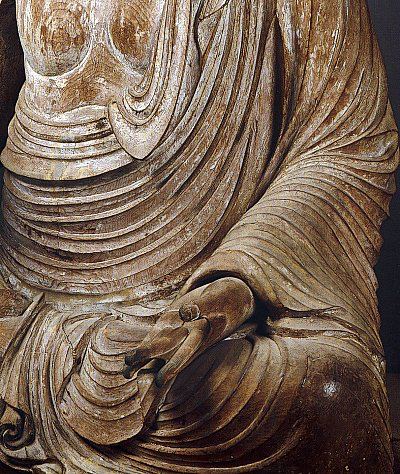
Courtesy of Comprehensive Dictionary of Japan’s National Treasures.
The way cloth is immortalized differs materially and stylistically from culture to culture, however, the attentiveness to drapery is a shared characteristic. In both classical Greek sculpture and Japanese Buddhist sculpture, one can see an initiative to capture free-flowing fabric in a static medium. This is seen in the famed Winged Victory of Samothrace, where elements of wet drapery are combined with outreaching wings. Likewise, in Japanese Buddhist art, tennin, also known as apsaras or goddesses, are also commonly depicted with wings and draped in light and diaphanous ribbons. Below, the winged celestial being, Karyōbinga, is seen carved in ivory, which could be worn as a netsuke (a functional toggle and adornment) on a kimono. Despite being miniature, this netsuke is highly detailed with every feather and fold in the garment carefully carved.
Although the size difference between the Winged Victory, depicting the goddess Nike, and the netsuke of Karyōbinga are in stark contrast, the desire to render celestial maidens with bird-like details and feathery fabrics remains the same across cultures.
If you are based in Chicago, take a look for yourself at the Art Institute of Chicago. Of Gods and Glamour is an on-going exhibition of Greek, Roman, and Byzantine Art featuring an array of examples of carved marble drapery, including a Roman statue of a seated a woman from the third century. Take a short walk down the hall to the ancient Asian exhibits, which feature a Japanese Seated Bodhisattva outfitted in a flowing garment from the eighth century. Compare the Roman robes to the ribbons draped around the Bodhisattva’s arms. Which way of detailing feathers and fabric do you prefer?
Winged Victory of Samothrace, c. 200-190 BC vs. Karyōbinga, ivory netsuke, late 18th century.

Courtesy of Musée du Louvre.

Courtesy of Guiseppe Piva.
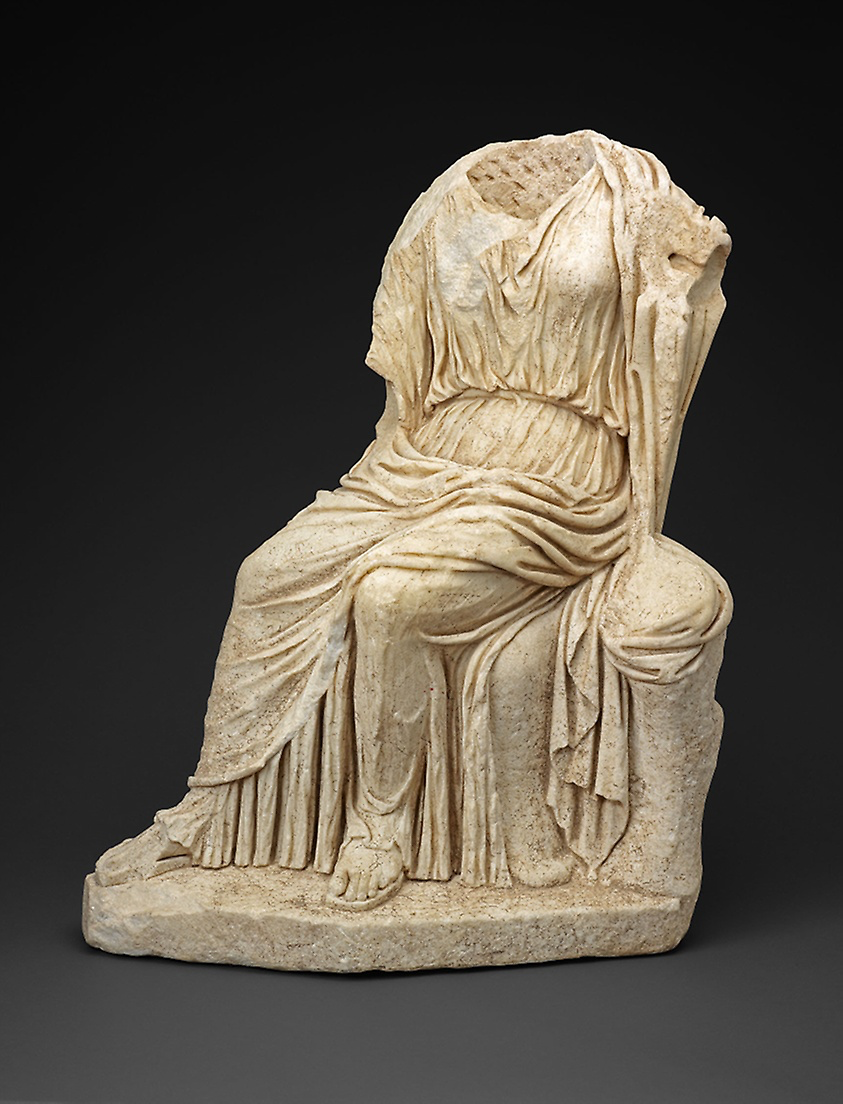
“Statue of a Seated Woman,” 2nd century AD, Roman, courtesy of the Art Institute of Chicago.

“Statue of a Seated Woman,” 2nd century AD, Roman, courtesy of the Art Institute of Chicago.
 Paragon Book Gallery